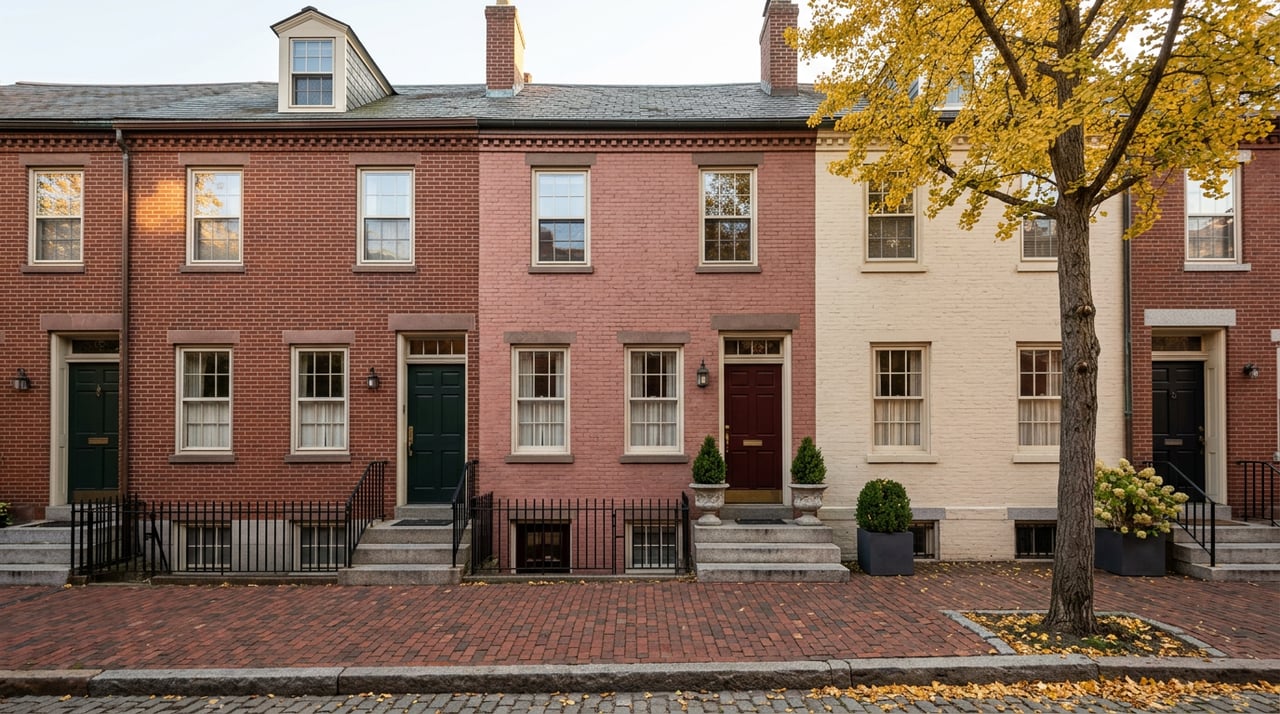
The Beacon Hill Architectural Commission exists to keep things the same. Its job, under the same review framework that covers everything from a new front door to a planter left on the sidewalk, is to hold the district's public face steady against the small daily pressure to change it. That is not a criticism. It is the entire premise of a historic district: someone has to say no to the satellite dish, the vinyl replacement window, the wrong shade of green paint.
On July 20, 2026, that same commission said yes to something with a completely different shape. Seven sculptures, each roughly eight feet tall, are coming to sidewalks and doorsteps across the district next year, backed by two of Boston's most established cultural institutions and built around guided walking tours that will send visitors past homes that have spent two centuries trying not to be looked at twice.
What the Commission Actually Signed Off On
The approval covers Be the Change, a public art exhibition organized jointly by the Vilna Shul and the Museum of African American History. It will run from May 2 through October 25, 2027, six months during which the sculptures sit at historic and community locations throughout the district. The project is built around three parts: the sculptures themselves, guided walking tours that start the same day the exhibition opens, and a slate of public programs meant to keep the conversation going after the initial installation.
The form of the sculptures is not incidental. Each one is shaped around the tzedakah box, the small container used in Jewish tradition to collect charitable contributions. Laura Mandel, the Vilna Shul's managing director of program strategy and impact, framed the choice in terms that reach past any single tradition:
"Be the Change stems from a concept that is core to Jewish tradition, but one that's also the most universal, and that unites us all. We hear so many people who are hungry for beauty and hope today, and we're honored to bring the exhibit to Beacon Hill and to celebrate the layers of history and community that are part of this neighborhood through it."
The artists behind the seven pieces draw on both Black and Jewish history, which is its own kind of statement for a neighborhood whose north slope absorbed waves of Irish, Jewish, and other immigrants through the late 19th century, and whose lower slopes have long held the Boston African American National Historic Site. The Vilna Shul itself fell into disuse after the 1950s, when the neighborhood's Jewish community began to disperse, and stood in disrepair before a community initiative restored it in the 1990s. Placing the exhibition here is not a random rotation. It puts the artwork in direct conversation with the ground it stands on.
Bigger Than Its Last Three Stops
Beacon Hill will be the fourth installation of Be the Change in the Boston area, and the jump in setting is worth sitting with. The first went to the Bolling Building from January 31 through March 14, 2025. The second moved to Boston City Hall Plaza from March 14 through April 4, 2025. The third landed at Chelsea City Hall from April 4 through May 16, 2025.
Every one of those is a civic address. A government office building, a municipal plaza, a city hall lawn. Beacon Hill is none of those things. It is a residential historic district where the loudest debates tend to be about window sashes and roof decks, not about where a temporary sculpture can legally stand for half a year. We've written before about how granular that review process can get, right down to a single roof deck on Pinckney Street that cleared the commission and still ended up contested. Be the Change is a different kind of test for the same body: not whether a private addition fits the district's rules, but whether seven pieces of public art can live inside it at all.
The Season Between Now and Then
None of this opens until next spring, which leaves a full year between the approval and the first sculpture going up. That gap is not empty. The Beacon Hill Civic Association's Fall HillFest returns to Mount Vernon Street on Sunday, September 27, 2026, and it already does, in miniature, what Be the Change is promising at scale. Past editions have paired live music and a dog parade with something closer to the coming exhibition's own DNA: guided architectural tours of the district, run by neighbors for neighbors, treating the streets themselves as the thing worth walking slowly past.
Charles Street, meanwhile, has had its own turnover this year. Chef Jamie Bissonnette's BCB3 Hospitality group, the team behind Somaek and the pintxo bar Zurito, opened Willie's at 20 Charles Street in spring 2026, a self-described neighborhood pizza and pasta spot that sits right next to Zurito and borrows flavors from both. A few doors down, inside the Whitney Hotel, Peregrine now serves a coastal Mediterranean menu from chef Tatiana Pairot Rosana, a two-time Chopped Champion cooking with a New England accent. And as of early September, a second location of a Hull-based Swedish candy shop opened on the Hill, adding salted licorice and gummy shapes to a street that already runs on antique dealers and small-format retail.
None of these openings are connected to the sculpture approval on paper. But they point at the same underlying fact: Charles Street and the blocks around it are absorbing more foot traffic and more reasons to linger than the neighborhood has had in a while, and Be the Change is going to land right on top of that momentum in 2027, not instead of it.
What This Actually Changes for Someone Who Lives Here
If you already live on the Hill, the practical takeaway is not "go see some art next spring." It is that the commission responsible for reviewing what happens to your own front door, your own railing, your own window has now set a precedent for approving something temporary, large, and citywide inside the same district. That is worth watching, not because it threatens anything, but because it tells you the commission's appetite for what belongs on these streets is wider than the roof deck disputes and paint color debates usually suggest.
It also means the next twelve months are a genuine on-ramp. The walking tour format that Be the Change will use in 2027 is close kin to the architectural tours HillFest has run for years on Mount Vernon Street. If you want a preview of how a guided walk through this district actually feels, September 27 is right there. If you want to watch how a temporary, large-scale public art project gets built out one certificate of design approval at a time, the commission's public hearings are open to anyone who wants to follow along, and the project's own site will carry updates on which artists and which addresses get named as 2027 approaches.
Beacon Hill spends most of its regulatory energy holding still. This is the year it agreed to look different on purpose, for six months, in public. That is not a small thing for a district built entirely around the idea that its face shouldn't change.
If you're weighing a move onto the Hill, or already own here and want a read on how developments like this touch value and demand, William Montero has spent more than three decades reading Boston's luxury micro-markets block by block. Let's Connect.
