On a Sunday afternoon in the South End, the neighborhood empties onto Thayer Street and doesn't come back for hours. Vendors set up under white tents, a line forms at whichever food truck smells best that week, and somewhere nearby a dog is losing a very serious game of fetch. South End residents have helped shape the neighborhood's outdoor life, from its markets and gardens to its parks.
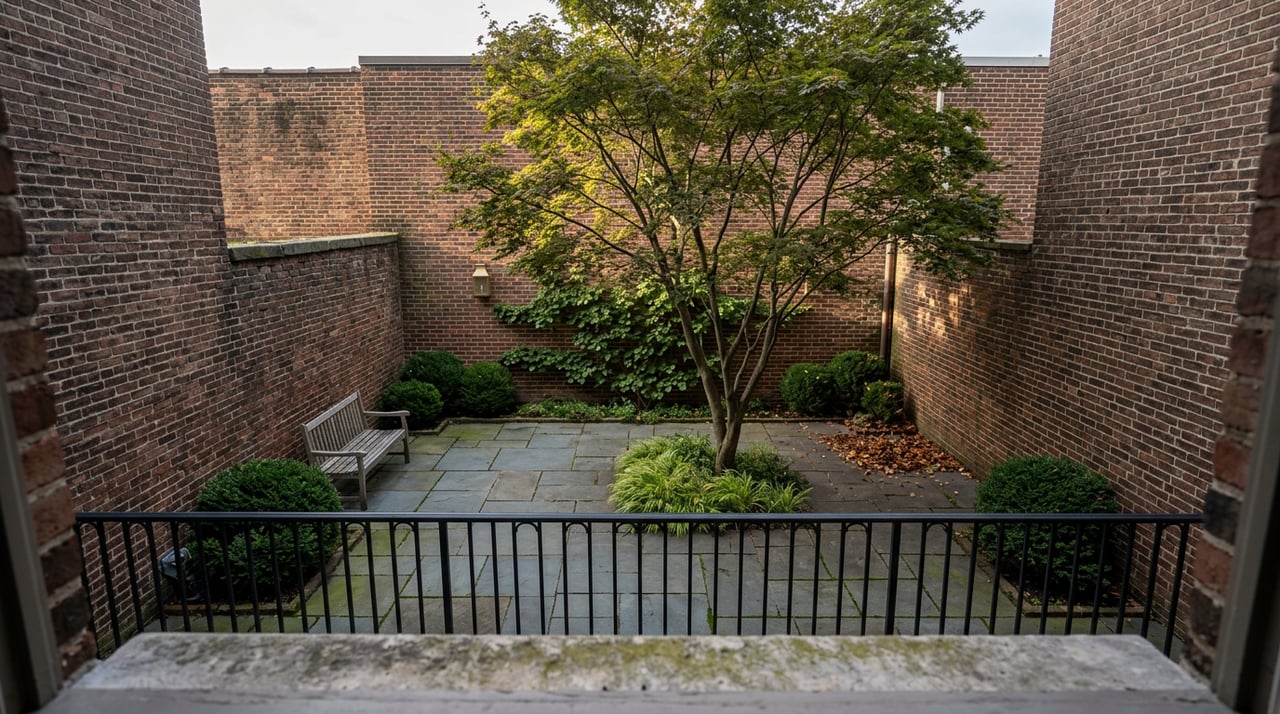
Outdoor life matters more in a neighborhood built almost entirely of attached rowhouses, where a private yard is a luxury few blocks actually have. When a place has no backyards to speak of, what happens to its outdoor life says something real about the people who chose to stay anyway.
A Market That Grew Into a Neighborhood Institution
According to WROR, SoWa Open Market has been running since 2003, longer than most of the condo buildings around it have existed. It's a private market that has grown into a neighborhood institution, taking over 500 Harrison Avenue and the pedestrian-only Thayer Street every Sunday from May 3 through November 15, 11 a.m. to 5 p.m., rain or shine. This season's roster runs past 250 vendors, with a rotating lineup of five food trucks each week that has included names like 10Cha Matcha House, Aquidneck Honey, and Cloud Crunch.
A few blocks over, the same organization runs a separate, year-round vintage market at 450 and 500 Harrison Avenue, so the browsing doesn't actually stop when the weather turns. And the South End Business Alliance layers its own free programming on top of the market itself, with instructor-led classes like Zumba and mat Pilates held right at the market grounds most Sundays at 1 p.m. Together, the market, its vendors, and the Sunday classes offer several ways to spend time there.
The Dog Park Shaped by Residents
Walk a few blocks toward Washington Street and you'll find Peters Park, which has a harder history behind its calm surface. The park is named for George and Sadie Peters, prominent figures in the South End's Syrian-Lebanese community from 1880 until 1966, when the Boston Redevelopment Authority took their property under the South End Renewal Plan. Sadie Peters spent years fighting the BRA's rebuilding plans and eventually won a public park dedicated in the family's honor. The Boston City Council's own tribute at the time praised the couple as citizens who "helped make the South End a healthy and viable community."
The dog run inside that same park has its own origin story, and it's a rougher one. A group of residents led by Joe Wex, Randi Cohen, and Doug Lester spent two years working to get the space officially recognized as a Dog Recreation Space by Boston Parks, a designation that required full private funding with no city money attached. They raised more than $360,000 to build it. There was real doubt at the time about whether a sanctioned off-leash space would work in a dense neighborhood like the South End, and the project was initially grandfathered in while the group proved it out. It did work, and it became the template other Boston neighborhoods later used to propose their own dog parks. Joe Wex died suddenly during the process, and the space was named for him in recognition of the effort. Today it's still maintained entirely through the Friends of Peters Park, a volunteer group that pays a private contractor roughly $950 a month just to keep it clean, funded through donations rather than any city line item.
Here's what that pattern looks like laid out side by side.
| Outdoor space | What it offers | Funding and stewardship | When it runs |
|---|---|---|---|
| SoWa Open Market | Art, food trucks, vintage vendors | Private market, self-sustaining since 2003 | Sundays, May 3–Nov 15 |
| Underground at Ink Block | Murals, dog park, fitness classes | Developer-built under a state infrastructure program | Year-round, free |
| Peters Park Dog Recreation Space | Off-leash runs for large and small dogs | 100% volunteer-funded through Friends of Peters Park | Year-round |
| Berkeley Community Garden | 158 plots, started as unauthorized gardening in the 1970s | Residents began gardening there before the city formalized it in 1976 | Spring lottery, growing season |
| Titus Sparrow Park | Tennis court, basketball court, playground | Neighbors advocated for the park in the 1970s; volunteer Friends group runs it today | Year-round |
Under the Highway, By Design
The most unlikely entry on that list sits under I-93 itself. Underground at Ink Block is an 8-acre stretch of former highway underpass between the South End and South Boston that a developer, working through the Massachusetts Department of Transportation's Infra-Space program, turned into a public park rather than leaving it as dead pavement. What used to be a gap between two neighborhoods now carries murals, a dog park, curated food and beverage pop-ups, and a regular schedule of fitness classes, all free to use. It's a different funding model than Peters Park, built by a private developer instead of a volunteer group, and another approach to creating public space.
The Garden's Early Years
Berkeley Community Garden sits on East Berkeley Street between Tremont Street and Shawmut Avenue, on a stretch of the South End where brick rowhouses came down during 1950s and 60s urban renewal and the land sat vacant for years afterward. In the 1970s, Chinese immigrant families in the neighborhood began gardening the lot without permission, growing bitter melon and other produce alongside the tomatoes and basil, fencing off plots with whatever materials they could find. The city formalized the space in 1976. Two years earlier, a Massachusetts state representative from the South End, Mel King, sponsored the 1974 Gardening and Farm Act that made farming vacant public land legal.
Today the garden carries 158 plots through Boston's official community garden directory, and getting one still runs on the same logic that built the place. A lottery every spring, held in person, open to Boston residents who are asked to live in the South End or close to the garden. Miss the drawing and you land on a waiting list that dissolves at the end of the growing season, meaning you try again next year. The garden remains a shared space shaped by both community initiative and city support.
The History of Titus Sparrow Park
Titus Sparrow Park tells a related story with a harder edge. The land at West Newton and West Rutland Streets held eight houses until a 1966 urban renewal project tore them down for public and elderly housing that never got built. For seven years afterward, half the lot sat empty and became a dumping ground while the other half was paved for Prudential Center parking, all while an actual twelve-lane highway bypass through the South End remained a real possibility. Titus Sparrow, a longtime Durham Street resident who spent his career pushing the city to build public tennis courts in neighborhoods it otherwise ignored, worked with neighbors Michael Joliffe and Ray Willingham to convince Boston to build a park on the site instead. Sparrow died in 1974, before it opened, and the finished park was named for him in 1976.
The park's most recent renovation continued the community involvement reflected in its history. The project cost $2.4 million, split between roughly $255,000 for design and just over $2.1 million for construction as part of the city's five-year Capital Plan, and it added new play equipment, a resurfaced tennis court, a more accessible basketball court, and underground stormwater infrastructure. The design process ran through public meetings starting in May 2021, and when the park reopened in November 2024, more than 350 neighbors showed up for it. The group that pushed the redesign through those years of meetings, and that still runs the park's free community programming today, is the Friends of Titus Sparrow Park, a volunteer organization built on the same model as the one keeping Peters Park's dog run clean.
The Actual Takeaway
Across the South End, outdoor spaces have taken shape in several ways: a market running since 2003, a resident-organized dog run, a park developed beneath a highway, a community garden begun by residents and formalized by the city, and a park renewed through a city capital project and community involvement. Together, they reflect the many ways residents, organizations, developers, and public institutions contribute to the neighborhood's outdoor life.
If you already live here, that's probably not news exactly, but it might be the first time you've seen the whole shape of it laid out at once. If you're weighing whether the South End fits how you actually want to spend a weekend, this is the texture that doesn't show up in a listing photo. For more on the neighborhood itself, our South End guide covers the streets, the architecture, and what makes each block feel different from the next.
If you have questions about the South End, its market, or what it's actually like to live a few blocks from Thayer Street on a Sunday in October, William Montero knows this neighborhood from the inside. Let's Connect.
